

Opposing forced sterilisation in Madagascar: the story of AFHAM
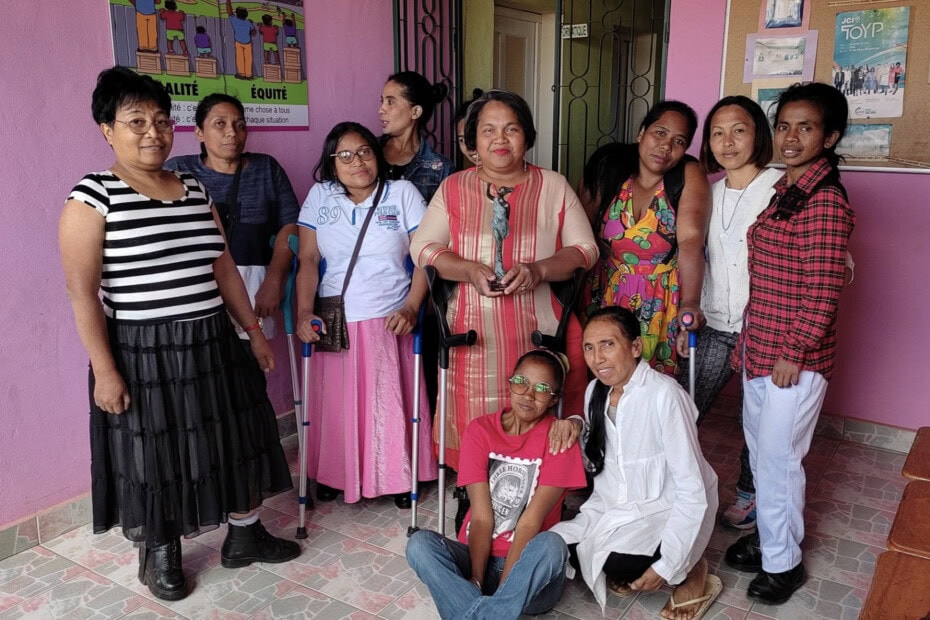
Across the country, Association des Femmes Handicapées de Madagascar (AFHAM) is changing what’s possible for Malagasy women with disabilities and making sure their voices are heard. Razafinjato Fela, president of AFHAM since 2011, shares the group’s journey and the changes they are leading across the country. ‘With or without funding, I’m an activist, because this is my life.’
By Annette Farshchi, Writer at Mama Cash
Can you tell us more about your work?
‘AFHAM exists to promote the rights of women with disabilities in Madagascar. We support them in flourishing in all domains and are fighting poverty. We are active in the entire country and have over 600 members. Together, we’re fighting discrimination with women that are claiming their rights. We’re the only group in the country working exclusively with and for women with disabilities. In our work, we focus on four key pillars: building capacity and leadership, researching disability issues in Madagascar to inform our actions, inform people about the rights and needs of women with disabilities and speak to decision-makers, and assisting our members directly when they need it.’

What is an example of something you do to support your members day-to-day?
‘It takes on different forms: for example, we donate orthopaedic equipment and help women over 18 access national ID cards. Many of them are afraid to show themselves or don’t have the means to go through the process. So, we need to help them, because without an ID, they cannot access services or be recognised as a citizen. They need an ID as proof they exist.’
What are some of the biggest challenges women with disabilities face in Madagascar?
‘First, lack of autonomy. Many buildings and roads aren’t accessible, and information isn’t available for people who can’t see or hear. Then daily life becomes extremely difficult. Second, harmful beliefs. In Madagascar, disability is often seen as a curse or a punishment. Some believe it’s contagious. Disability is seen as an individual problem or a medical condition that doesn’t consider people’s surroundings. People are rejected from their community and discriminated against. Some think that people with disabilities should be hidden or institutionalised. They are not given space in public life, and they are almost never involved in decision-making.
At AFHAM we try to change this in different ways. We organise awareness raising campaigns, such as a workshop on the rights of people with disabilities, where we invite local officials. We also speak at events about human rights, where we make sure women with disabilities are not forgotten. And we run radio and television programmes to reach wider audiences, where we also invite policy makers. In these key ways we talk about rights and shift public opinion.’

How has your advocacy helped to make a change?
‘One important example is the law that protects women from gender-based violence, which passed a few years ago in Madagascar. We made sure that it includes protections for women with disabilities. For instance, it now requires informed consent for medical procedures, something we pushed for because some women were being sterilised without consent. We launched a project on sexual and reproductive rights called “Our Body, Our Choice”. With support from our partners, including Mama Cash, we helped implement the law in hospitals and clinics. Women now know their rights and can say no. These are major steps forward.
Furthermore, in the past, women with disabilities could not vote because polling places were inaccessible. After changes were made to remove these barriers, they can now vote. Some are even running for office at the local and national levels. Before AFHAM was founded, very few worked in mainstream companies. Thanks to our partnerships and advocacy, women with disabilities are now employed by women-led businesses and other companies.
We follow up on every activity to see what has changed. We ask members how their lives have improved and conduct surveys to measure perception. If a company begins hiring people with disabilities, we share the story in newspapers and stay in touch. We also use radio shows to hear directly from the public.’

How has Mama Cash supported your work?
‘Mama Cash has supported us since 2012. Thanks to you, we joined the defence of rights league and contributed to the law on gender-based violence that passed in 2021. The flexible nature of your funding has been key. If something important comes up, like a last-minute meeting 100 kilometres away from the capital, we can attend. This ability to respond in real time helps us stay visible and effective.’
What advice would you give other groups of women with disabilities around the world?
‘Come together. Create or join an association. For me, it’s the only way to make your voice heard. Here in Madagascar, there are many more women with disabilities than our 600 members. We are stronger together. Also, be patient. The work is slow, and funding is not always available. But change takes time and persistence.’
If you could dream big, what would you hope for AFHAM’s future?
‘In our 14 years, we have built a strong reputation. We are known and respected in the community. My biggest dream is for Madagascar to fully implement Law 97-044, which guarantees the rights of people with disabilities. Right now, it exists but isn’t applied everywhere. We want to see it enforced fully within four years, so that people with disabilities can fully enjoy their rights. That will take strong advocacy, legal experts, and committed support.’

How do you keep doing this work?
‘I’m a woman with a physical disability. I live with it 24 hours a day. With or without funding, I’m an activist, because this is my life. It’s never exhausting or tiring because I work out of conviction. I know the struggles our members face, because they are mine too. And as long as I’m alive, I won’t stop fighting. I think only death can stop me.’
AFHAM shows what is possible when movements led by women and girls are trusted and funded. Their work has changed lives and laws and opened doors for hundreds of women. They are ready to do more. And with your help they can make it happen.
Donate today to help AFHAM advance justice, dignity, and inclusion for women with disabilities in Madagascar.
This interview has been edited for length and clarity.