

Climate change is not equal: Indigenous women with disabilities are taking action
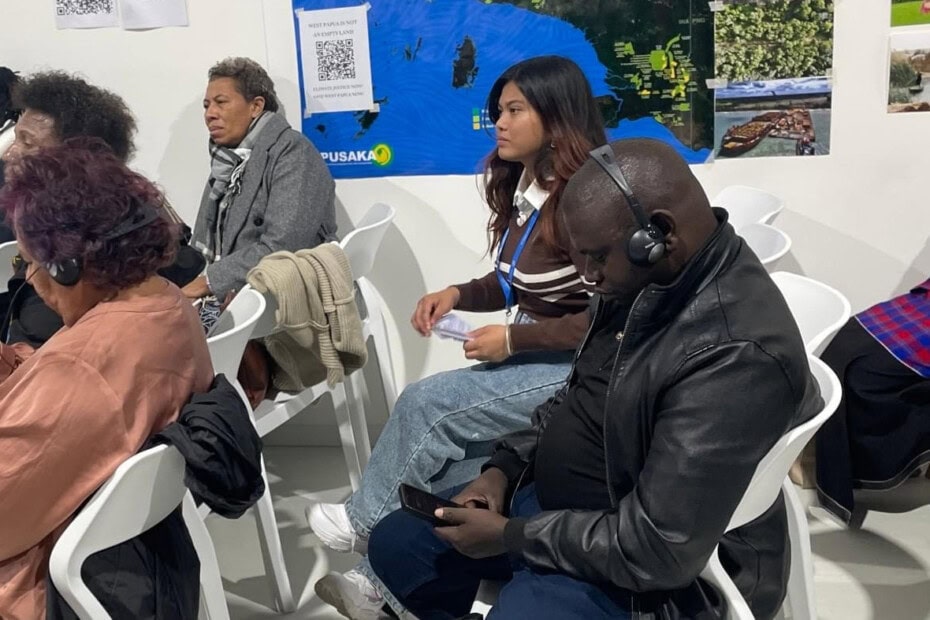
We’re excited to share the stories of some amazing feminist organisations that are making a real difference in advancing climate justice. Over the course of 2025, we have been posting blogs about some of our grantee-partners that attended the 2024 UN Climate Change Conference. As we look forward to the next conference, these stories show us how communities most impacted by climate change are also the ones implementing and leading the solutions with lasting impact.
By Jailan Zayan
Climate change affects us all, but not in the same way.
In Nepal, Indigenous women and girls with disabilities face some of the hardest challenges. On top of the changing climate, they deal with systemic inequity and disability. At the 2024 UN Climate Change Conference, Bhawana Majhi of National Indigenous Disabled Women Association Nepal (NIDWAN) brought a clear and urgent message: the fight for climate justice must include those most affected and least heard groups like Indigenous women with disabilities.
Multiple barriers
“Women with disabilities are already a marginalised group,” Majhi said. Those who are Indigenous, from impoverished backgrounds, or groups with multiple marginalised identities face even greater exclusion and invisibility, she explained. Access to funding, personal assistants, and mother tongue and sign language interpreters is rarely available for Indigenous women with disabilities in Nepal: “We are embedded within multiple layers of direct and indirect barriers,” added Pratima Gurung, Founder and Advisor of NIDWAN.
Language is another major challenge. “Nepali is our first and official language, forcing many Indigenous people to limit the use of their mother tongue, as all services are provided in Nepali,” said Gurung. While the state mainly promotes the Nepali language, Indigenous peoples often struggle to use it. This means they cannot freely express themselves or participate in decision-making.
The climate crisis is only intensifying these challenges.
Community forests, vital to Indigenous people’s livelihoods, have become battlegrounds.
State-led normative frameworks and government-driven development projects systematically exclude women from accessing the very resources they depend on. “They rely on the forest resources, but these days they can’t access the forest, water, land, and biodiversity. That limits their livelihood and creates cultural, social, and economic disparities,” Majhi said.

Left out of decision-making spaces
This exclusion is part of a much bigger problem: systemic inequity. In male-dominated systems, Indigenous women with disabilities – especially those from marginalised ethnic groups or castes, or those living in poverty – are consistently left out of decision-making spaces.
Even within Indigenous organisations, men often dominate leadership and advocacy, leaving women without the opportunity to share their experiences or help create solutions.
At the climate change conference, NIDWAN shared a video revealing how climate change is affecting Indigenous women with disabilities. It showed how environmental policies and capitalist systems are making their lives harder – cutting off access to safe drinking water, increasing food scarcity, limiting access to forests and biodiversity, increasing safety risks, and allowing extractive projects to take place on or near Indigenous lands. “Everyone came to watch the video, and they were so inspired that we are talking about the intersections of gender, disability, and Indigeneity,” Majhi said. “These are the realities of our daily lives and we need to raise awareness about them. The UN system, Member States, and all relevant stakeholders need to understand our issues and include us in every process. Too often, we are left out of discussions, despite already being in vulnerable situations.”
Majhi’s presence at the conference gave her the chance to share stories of resilience and call for urgent change. But NIDWAN’s participation was not a given: “We don’t get funding to attend such important meetings,” Majhi said. Mama Cash made it possible for them to be there and share their stories with the world.

Changing the Paris Agreement
Since 2015, NIDWAN has been working to bring the lived experiences of Indigenous women with disabilities into international climate conversations. All these efforts connect the real-life struggles of people on the ground with international advocacy. “But our work is not limited to storytelling. We have played a key role in integrating words like ‘women,’ ‘Indigenous peoples,’ and ‘persons with disabilities’ in the official language of the Paris Agreement,” said Gurung. “We have ensured that these identities are recognised in climate policy and have paved the way for all marginalised groups collectively. Still, much more has to be done through an intersectional climate justice framework, because we are not only vulnerable due to the climate crisis, we are also contributors. We are transforming our advocacy into action, from the local to the global level.”
With support and solidarity from Mama Cash, NIDWAN recently provided emergency aid to communities hit by floods.
They are also pushing for long-term policy changes in collaboration with the government in Nepal and other stakeholders. Because leaving out marginalised groups from decision-making spaces is not only unjust – it undermines effective solutions.
NIDWAN’s work shows that people living at the intersection of disability and Indigeneity have important knowledge to address the climate crisis.
Leaders, not an afterthought
The 2024 UN Climate Change Conference was a vital step for NIDWAN, but it was only the beginning. With the next climate conference set to take place in Brazil in November, NIDWAN will bring ground-level evidence to advocate for climate-just policies that include and uplift Indigenous women and girls, including all people with disabilities.
Indigenous women with disabilities must be seen not as an afterthought, but as leaders in the fight for a just and sustainable future. You can help make this happen. Support the women of NIDWAN by donating today.
Find more stories about Mama Cash partners working on climate justice, ahead of the 2025 UN Climate Change Conference, here.