

A Lifeline for Women’s Mental Health in Kyrgyzstan
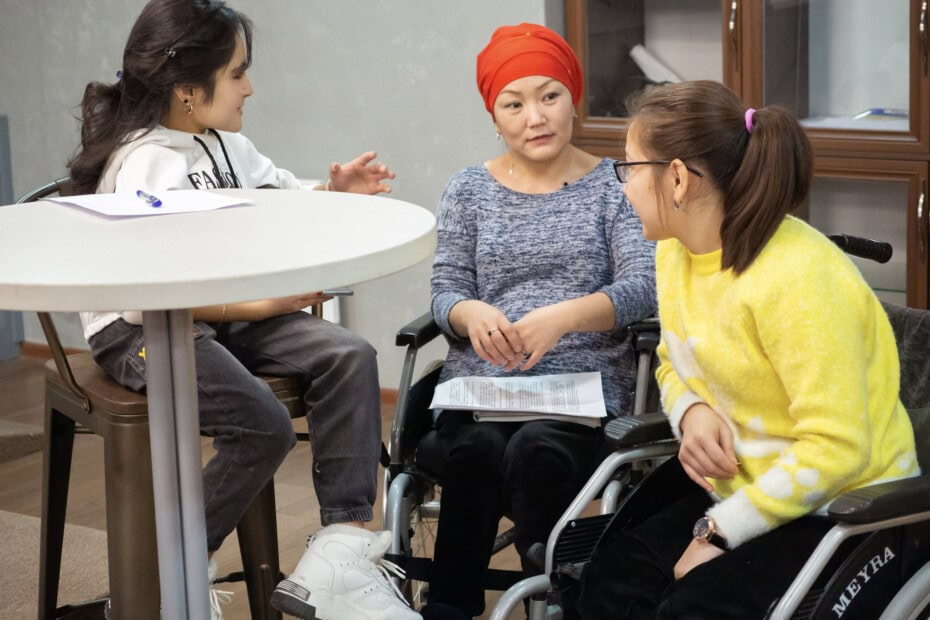

In honour of Mental Health Day, we spoke with Ukei Muratalieva, Director of Nazik Kyz, a grantee-partner supporting women with disabilities in Kyrgyzstan. Through peer counselling and a hotline, Nazik Kyz offers vital mental health support. We asked Ukei about the challenges women with disabilities face, the impact of Nazik Kyz’s work, and how Ukei protects her own wellbeing in the process. ‘For many, we are still the only thread of support and hope.’
What are some unique mental health challenges that women with disabilities in Kyrgyzstan face, and how does Nazik Kyz help address them?
‘Women with disabilities in Kyrgyzstan face multiple barriers. They deal with fighting two stereotypes: both as women and as women with disabilities. Some of them can’t physically access medical and psychological services. On top of that, they often feel isolated and experience discrimination. Mental health is rarely seen as a priority, because women with disabilities are focused on basic survival and finding support daily.
With the support of Mama Cash, we’ve created a system to help. We run a hotline where women with disabilities can get psychological support. We offer self-help groups for women with disabilities, peer-to-peer counselling, and referral to specialists. People with or without disabilities of different ages turn to us. All the hotline staff are women with disabilities with either formal or informal training in psychology. Their personal experience and expertise in disability issues is a unique advantage that makes our assistance especially valuable and profound.
We try to create a safe space where women feel heard, understood, and supported, no matter where they live. For many of them, it’s the first time they feel like their voice matters.’

Can you tell us about your work to provide psychological support? What does a typical day look like on the hotline or in peer counselling?
‘Our hotline employs four women-employees with disabilities. They work five days a week and take calls from women who need emotional or psychological support. If a case is particularly urgent, it’s passed on to me as a manager. I then work with a group of experienced women leaders with disabilities to decide the best way to help – usually within a few hours or days, depending on how complex the situation is.’
Can you share a moment that reminded you why this work matters?
‘During and right after the pandemic, we clearly saw how people with disabilities were treated by society, and even by people close to them. When resources were scarce, women with disabilities were often the first to be left without support – they were abandoned, divorced, and sometimes literally kicked out of their homes.
For many, our hotline became the only place to get help. We delivered food, referred them to friendly doctors, and arranged temporary accommodation in care homes. We supported over ten pregnant women with disabilities who received support from us in accompanying their pregnancies and were able to give birth safely.
These cases are especially reminiscent of how important our work is – because for many women with disabilities, we are still the only thread of support and hope.’
Supporting others can be emotionally hard. How do you take care of your own mental health while doing this work?
‘Each of us needs support, whether we have a disability or not. Therefore, twice a year, we organise a three-day supervision for our hotline team. Mental health specialists help them recharge.
And once a year we hold an event for the entire team to prevent emotional burnout. This helps to strengthen the team, keep internal stability and give mutual support – especially in times of crisis, when the legislation concerning civil society work is constantly changing.’

Nazik Kyz has been a grantee-partner since 2017. How has this partnership supported your work?
‘Thanks to the support of Mama Cash, we launched Kyrgyzstan’s first hotline for women with disabilities in 2019. We created not just a support line, but a whole system of mutual aid. For example, in cases of sexual violence, we transfer appeals to a group of women leaders. Affected women with disabilities get comprehensive support, including the possibility to stay in a shelter for 1 to 6 months.
Right now, 14 women with disabilities are living in our shelter, which we run with a partner organisation led by persons with disabilities. This kind of support is vital. It not only saves lives, but also restores a sense of dignity, confidence, and faith that they are not alone.’
Support groups like Nazik Kyz by donating today.
